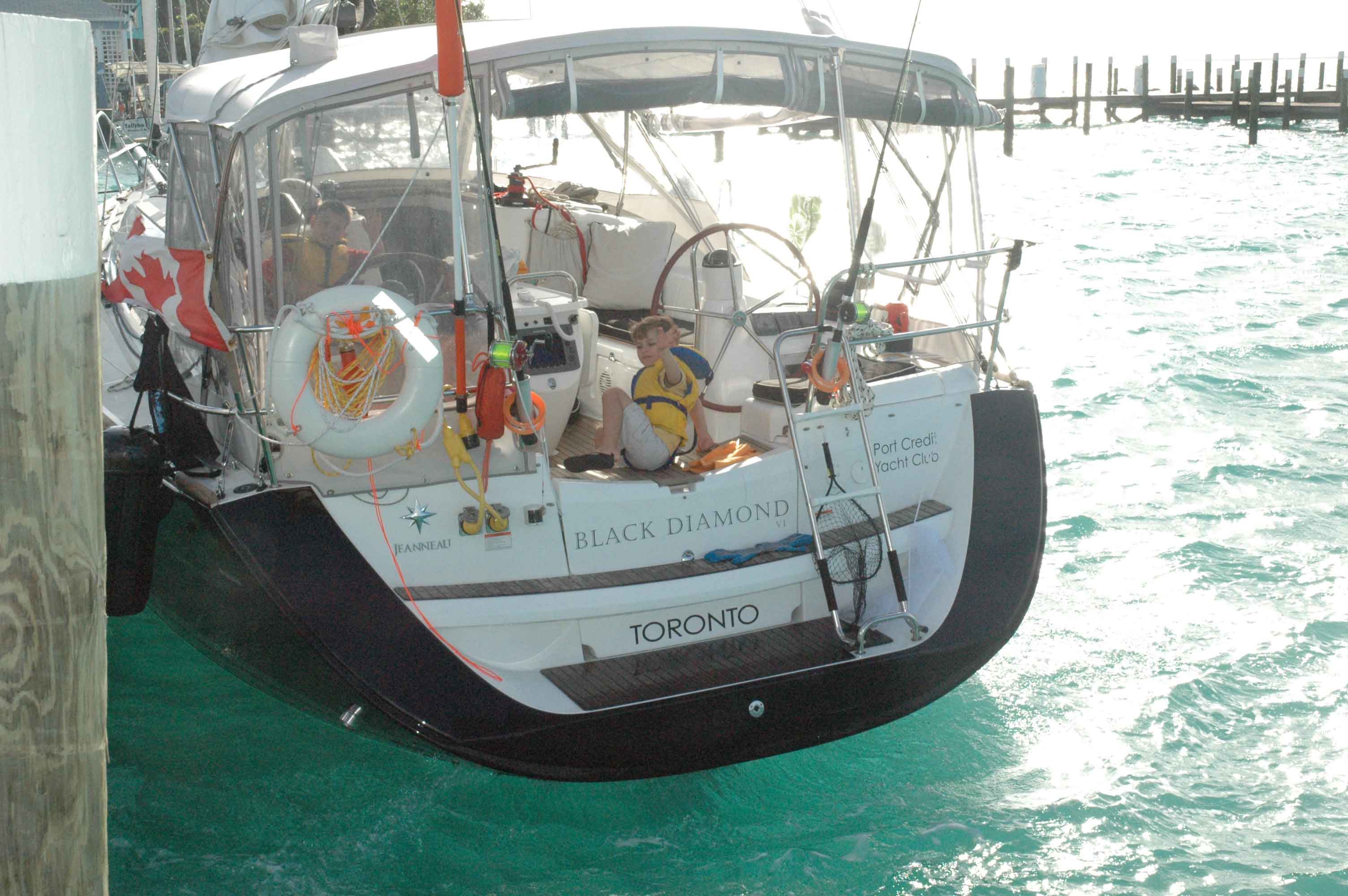
Scroll Down to bottom of this post to view.
Leaving Marsh Harbour, Via Lynyard Cay Cut, North Bar Channel, Exit on our way to Nassau.
This is the same cut that the Tragedy in 2010 happened to “Rule 62″ during the Caribbean 1500 Rally.
—————————————————–
Tuesday December 16th -17th, 2008
Crossing the Sea of Abacos – Marsh Harbour to Nassau

The beach in Marsh Harbour.

The Playground on the Beach in Marsh Harbour.

The boys love a playground either in Canada or in the Bahamas.

We spent 3 days at the Conch Inn & Marina in Marsh harbour.

Ed and Pudge, if its not obvious. Base for Chartering Moorings & Sunsail in the Abacos.

A little Rest & Relaxation.

Christmas Decorations everywhere, but still does not feel like Christmas.
Fire aboard Black Diamond, could have lost the whole boat!
After dropping Andrew off in Marsh Harbour for him to catch his flight back to Toronto. We explored the town and did some laundry. After getting back to the boat, I plugged in the shore power. Roxane was cooking some dinner and I started to watch a movie with the kids. I heard a “Little Popping Sound” but was not sure what it was, Thomas was sitting on the companionway steps, and was kicking the walls. So I was not sure if it was him making the noise or something else.
Shortly after we smelled smoke and something burning. Not sure what it was, if was the stove Roxane was cooking on, or what. Then we saw smoke coming out of the rear storage room where the batteries, charger and inverter are located. All this happened within about 30 seconds of plugging into the shore power. I ran outside and to the front of the boat, where I quickly unplugged the shore power. By the time a ran back to the boat, about 15 seconds later, Roxane and kids were sitting on the dock. By this time, flames and smoke was immerging out of the storage room window. I got back inside the boat, grabbed the fire extinguisher, opened the storage room door, and pointed at the flames, and in about 12 seconds the fire was completely out. Total time to putting out fire from moment of hearing pops about 1 minute, from smelling the smoke, about 30 seconds. It was very scary, we could have easily lost the whole boat. We could have been left sitting on the dock with the shirts on our backs and nothing more. If I could not put the fire out, and had it spread a little further, it may have been impossible to put out. The fuel tank was not far from the fire. Also the power boat next to us had 2,000 liters of fuel onboard. Had we simply plugged the boat in, and then went to explore the town, we would have come back likely to find half the marina missing.
I can only thank God for the way this event came to close and everything ended well, and no one was hurt at all. After coming back to Toronto and speaking to a couple of folks, I heard a story about one man that this exact thing happened to while he was sleeping. By the time he got up and escaped 60% of his body was burned. He jumped into the water to put the fire out on his skin. He ended up dieing in the hospital from infections.
Legally you only need to have 2 fire extinguishers on aboard a boat our size, but from now on I will keep 4 on board. Each is only good for 12 seconds of spray. Also if you are using one of these to put a fire out. Stand back about 6-8 feet, and aim at the base of the fire. This works best.

Hydrogen Bomb, Battery Explosion aboard Black Diamond.
Once everything settled down, I realized that the inverter was not working, and we had no power to the boat at all. I thought the worst. The charger/inverter was fried. About $4,000 to replace, but worse than that, you could not get one in the Bahamas. We could not go on without charging ability, or an inverter for powering various appliances on the boat. I called Roxane’s uncle Paul Thornton, also the electrician for the Spirit of Canada Open 60 and Falcon GT sailing from Bronte to Australia. He was in the middle of renovating his house, and knee deep with contractors and other hassles. Yet, he was stilling willing to fly down with parts to fix our boat. He suggested I call him in the morning, once I had a chance to better asses the damages. I would definitely recommend Thornton Electric to anyone.
The next morning it took me the whole day to empty the storage room and clean all the white extinguisher powder. I disconnected the battery you see above. Noticed that there was virtually no damage to the battery cables. There was very little fire damage to the boat either, just cosmetic. It’s in the very back of the storage room, no one will ever see that anyways. The Moorings Marina was very helpful, they offered to lend me a battery to reconnect the circuit. Once I did that, everything came back to life, the inverter was again working. Then the Moorings sent a boat electrician by to look over the whole boat and battery banks. They said they will be happy to pay the electrician themselves. I wondered if they were worried about being liable for any damages. The boat next to us also had some problems after plugging into the shore power, the head of his shore power cord exploded and started to burn. They said they have experienced surges on the island from time to time. In any case, the electrician gave the boat a clean bill of health. However he said, I did not maintain the water levels in the batteries, and this contributed to the problem.
After discussing this with many boat Electricians. This is what I think caused the fire.
Angus Yachts had installed an additional battery to the bank for our trip. They installed the new battery directly next to the charger with about a foot length of wire. The other batteries are 8 to 10 feet from the charger, and below the floor boards with less oxygen to feed the fire. The battery that exploded was the newest battery in the bank only 4 months old. The other 4 batteries were 8 months old, they did not explode.
The kind of cruising we were doing this year, 70 days of sailing in Toronto another 20 days up to this point down south, charging and depleting batteries many many times. This will burn away the liquid in the batteries quicker than normal. However, I was only told to check them once a year by Angus. After checking the batteries that were still in the boat, the liquid still appeared to be pretty good. Also that does not explain why the 4 oldest batteries did not explode but the newest one only 4 months old did.
Basically, the batteries were severely depleted, and when the charger was plugged in, it started dumping a heavy load of power into the bank. However, the newest battery installed by Angus Yachts right next to the charger with only a foot of wire. Got the brunt of the load. Quiet possibly, the fluid could have been lower than the other batteries, due again to the placement of this battery. At every charging it would have received too much load and this would have prematurely depleted the battery fluid. Then finally at this point in time, there was very little fluid left, and this created a hydrogen bomb right in the boat. When I plugged in again it got the brunt of the power, and exploded. Had they been installed where they were suppose to be installed, under the floor board, less oxygen would have gotten to them, and the damages would have been far less. But more importantly, they would not have exploded or caused a fire, since the batteries would have been equally charged, and the liquid would not have prematurely depleted in this battery.
Leaving Marsh Harbour, Via Lynyard Cay Cut Exit on our way to Nassau.
This is the same cut that the Tragedy in 2010 happened to “Rule 62″ during the Caribbean 1500 Rally.
This whole battery situation delayed us about one or two days, and finally we were ready to leave for Nassau. After refuelling and filling the water tanks we left Marsh Harbour on Tuesday at about noon. Our goal was to make it to the most southerly part of the Abacos by the end of the day about 50 nautical miles, called “Hole in the Wall”. I guess they call it that because it feels like you are in the middle of nowhere. The other day we passed a rock called, the “Centre of the Earth” – they are very creative in naming their islands. We planned to anchor for the night, then the next morning cross the Sea of Abacos about 60 nautical miles to the Island of New Providence, Nassau. We had reservations at the Atlantis Resort and Marina, where we were meeting Sorin Tirt and his girlfriend Adriana. They flew in on Wednesday the 17th from Toronto.

Roxane and Alexander enjoy lunch underway.
The weather was beautiful today, sunny, warm and perfect wind conditions for Black Diamond, 15-20 knots. We sailed around the north part of Marsh Harbour, tacked around “Matt Lowe’s Cay” This was labelled as a private island on the charts. We wondered if this island belonged to Matt Lowe, the actor? I again had to be diligent with the navigation, plotting on paper charts every few minutes, and watching the chart plotter carefully. With a little more confidence now, I kept all the sails up, tacking and gybing around tight corners, navigating between rocks, shoals and islands following the non direct passage to the South. I now know what it means to have a shoal draft. However, I still don’t regret having the deeper keel for ocean stability, and to help us sail closer to the wind. I thought it would be a lot worse, knock on wood, fortunately, we have not yet grounded, or hit anything in these shallow waters.

Just look at the colour of the water!
We were navigating on the inside of the Cays on our way south. As the afternoon went by the wind picked up, 20 to 25 knots. At some point we would have to cross between the cuts to the outside on the open Atlantic. The seas were about 2 feet on the lee side of the Cays so we wondered what it was going to be like on the outside. We noticed a sailboat making her way north on the outside so we decide to make radio contact. We hailed them, the boat turned out to be from Montreal, called Latitudes and was travelling with another boat called Bahama Bob. They were coming from the Berry Islands, far south, and were trying to make it to Marsh Harbour. The report was the seas were very rough about 10 feet, the whole Atlantic Ocean to the east gave ample room for fetch. Fetch is the amount of open sea the wind has to build waves. But worse than that, these boats had been trying to get in through the cuts, all along the coast with no luck. The cuts between these dangerous rocks are very narrow. As the 10 foot seas were breaking on the shallow waters and rocks, the waves built to over 15 feet. The depth in the cuts is only about 15- 20 feet. If you try to enter and ride the swells in on the lowest part of the wave, you will ground out very hard, possibly sinking your boat. We passed each other at one of these cuts, we could see the waves rolling in, and it looked like a surf you might find in Hawaii. The worst part for these boats was that it was going to be dark in about 2 hours, and they desperately wanted to get in. Through our radio conversation I suggested that they keep heading north to the next cut, which was not facing directly east into the waves. I also consulted my Sirius Satellite weather, which showed the wind would drop to about 15 knots by the time they reached it. They were concerned that they would not reach the next cut by dark, and that it would not be any better. I gave them my report and told them that we made it here in two hours and that this would be their best bet. They took my advice and headed north.

A little shot of the rage seas breaking on the rocks.
In the meantime, we could not get out, and would not make it to “Hole in the wall” tonight. Instead, we decided to anchor in front of a beautiful beach near a place called Little Harbour. This was the first time we used our dinghy with the electric motor. Both were purchased from “The Store” in Port Credit. I thought electric was a good choice so I would not have to worry about storing or spilling gasoline in the boat. Also, it would save room in the dinghy since I would not need a gas tank. The motor itself is very light and small, and easy to handle, yet still pretty powerful for an electric, the equivalent of 2HP. It’s called a Torqeedo made in Germany. However, after reading a few guide books they suggested much stronger motors for battling the strong winds and currents in the Bahamas. This made us a little nervous about getting in the dinghy and being washed away from the mother-ship.

The boys testing out the dinghy - The Diamond Shuttle!
We anchored about 300 feet from shore, pumped up the dinghy, assembled the motor, and brought our trusty little dinghy anchor in case we could not control the drift. At first, we tied the dinghy to the boat while we tried to go up-wind. It was not a problem at all, the motor was definitely strong enough. The kids and Roxane joined me in our newly named dinghy, the “Diamond Shuttle”. I steered directly into the wind and then over to the island, we used the same route back to Black Diamond, if we were over powered by the wind, we would at least be pushed back to the mother ship. There were no problems, we have since used the Diamond Shuttle a few times, and it works well.
The island was amazing, with beautiful white sand. The kids enjoyed hunting for shells, and whenever Alexander found one with an animal inside it was an extra treat for him. He found one with a little crab-type creature in it, complete with a little crab claw. Thomas is not to fond of animals and persuaded Alexander to leave this one on the island. We walked all over and explored the island. On the windward side of the island, we could still see the large seas breaking on the rocks. We hoped that by the next morning it would be calmer so we could leave to Nassau. We made our way back to Black Diamond before dark, to settle in for the night.
I radioed the two boats we met earlier, Latitudes and Bahama Bob, to find that they safely made it to Marsh Harbour. They arrived just before sunset, and the winds had settled down to about 10 knots, and the opening was not facing the open Atlantic. They thanked us for the advice, and we both signed off for the night.

Roxane is getting really good at baking, pizza, cakes and bread on the boat.
Scary exit of a cut the the Atlantic Ocean.
The next morning at about 6AM the wind was blowing about 10 knots, perfect, so we set out as soon as possible. We made it to the North Bar Channel Cut. It looked better than the day before, but still scary, 12 foot swells, but at least they were not breaking or surfing. However, the opening was only 200 feet wide, and was hard to judge where the opening was as the rocks were awash and under the large swells. If we miss judged it would have been disastrous. We were debating if we should try it or not, when I noticed a range marker on the chart. Range markers, are two lines of sight on the shore, if you line them up in your vision, like sights on a gun, you will have a straight line passage that marks the safest route. Roxane was very scared so I gave her a job. Her job was to line up the marks which were behind us. She instructed me to steer a little to port or a little to starboard, etc. I tried my best to helm straight out the cut. Black Diamond climbed the 12 foot seas, some of them close together, and the hull slammed the water as it dropped hard a few times. The children thought it was all great fun, as they got butterflies in their stomachs. Many times when Roxane and I are a little nervous or stressed, the kids just sit in the salon watching a movie, as if they were at home in the living room. None of this seemed to bother them at all, probably because both of them have spent most of their lives on boats. The good news is that we made it outside the cut in a few minutes, and all went perfectly fine.
On the outside, the wind was 10-15 knots, and 3 to 6 foot seas, a walk in the park. The sun was shining making it a beautiful 80 nautical mile sail to Nassau. (Due to the fact we did not get to “Hole in the wall the night before, today we had to cover more ground.) As we sailed we trolled two fishing lines off the back of the boat. To our surprise we noticed that we had caught something. Roxane helped me hold the rod as I reeled in this monster for approximately ten minutes. My arm started to feel like spaghetti because at the time we were sailing 8 knots, which made reeling in a fish extra challenging. I let the sails out, steered closer to the wind, and even put the motor in reverse. This is what the sport fishermen call backing down on a fish. Not sure anyone has ever tried it in a sailboat? Finally, the fish was in – we caught a Barracuda about the length of my arm. We had to throw it back because larger Barracudas are known to cause ciguatera poisoning. We continued sailing for a total of 11 to 12 hours and arrived in Nassau harbour that evening. We anchored the boat just outside of the Atlantis Resort and Marina because we did not want to pay $160 just to sleep the night at the marina.

Reeled in a large Barracuda near the "Hole in the Wall, Abacos."

It was much larger than it looks! What a fighter too!

While we sail through the night in 15,000 foot deep seas, this is what the boys are doing.


